Too Clever by Half

Case studies / Client work

The wrinkle radar: consistent numbers through a transformation

A large US retailer outsourced a whole product team, and the numbers still had to add up. I connected Claude to Jira to catch bad board hygiene, teach the fix, and keep leadership's comparisons fair for a year of constant change.

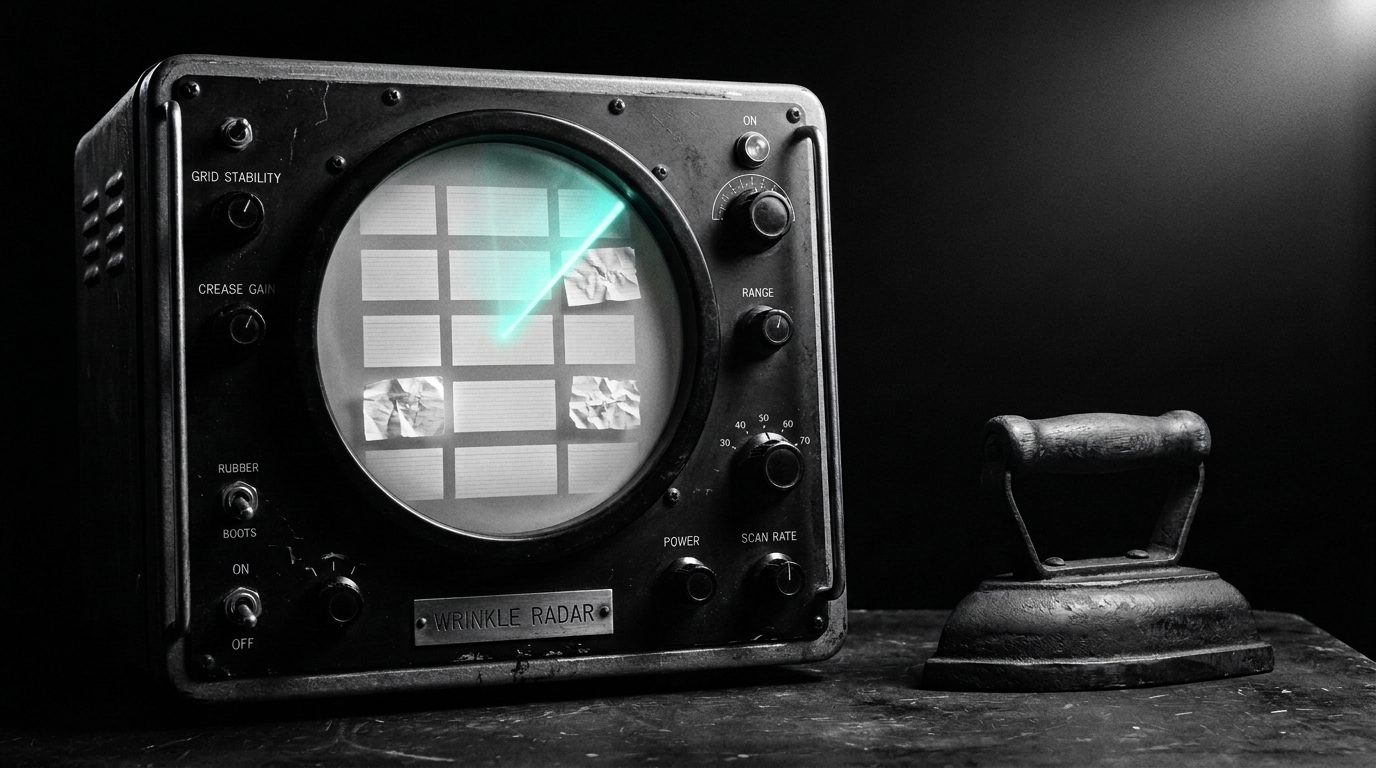
A vintage radar console whose screen shows a grid of index cards, three of them crumpled. An old cast-iron iron sits beside it.
Proves
AI can hold a standard steady while everything around it changes, when a person decides what the standard is.
Client
A large US retailer, through a global technology company
My part
Measurement, Jira hygiene and an AI “wrinkle radar” for track leads
Duration
About a year
Built on
Claude, connected to Atlassian Jira

Read

Everything was moving

A large US retailer had just outsourced the entire UX and engineering team behind one of its digital products to a global technology company. I came in through that company. Everything was in flux, and the team still owed leadership numbers. Consistent numbers.

But nothing had been set up to capture them, and nobody had been trained. So the first job was working out what actually needed to be captured. The second was making sure the Jira boards were clean enough to capture it.

The wrinkle radar

I connected Claude to Atlassian to do two jobs. The first was pulling the numbers. The second was a radar that told each track lead when their board wasn’t in a condition to produce those numbers properly.

It looked for wrinkles like these:

  • Time remaining left on a ticket that was already done.
  • A ticket closed without any time logged against it.
  • Estimated hours on the Epic instead of the Story.

For every wrinkle, it said what was wrong, explained how to fix it, and linked straight to the ticket. It worked as an SOP validator and a trainer of best practices at the same time. The leads weren’t just told they were wrong; they learned the habit.

Apples to apples

Over the year, the client kept changing things: the make-up of the teams, what was being measured, who was working on what. Even the operating model shifted. My job was to keep comparing apples to apples, so that leadership could see what was improving, even while everything was changing.

The answer was in the labels. By understanding how work was labelled, we could keep the UX tracks separate, even when they were renamed or merged. We could also follow tickets through their whole life, as they were rejected, moved, migrated or morphed into something else. The history held, even when the structure didn’t.

It got harder as the year went on. We pulled it off.

What still needs a human hand

The radar could find every wrinkle. It couldn’t decide what a fair comparison looked like once two teams had merged or a metric had been redefined. That took someone who understood the work, the people and what leadership actually needed to see.

Consistency through transformation isn’t a setting. It’s a judgement call, made again every time something changes.
Use it

Try it yourself

You can run a wrinkle radar on your own board. If Claude is connected to Jira through the Atlassian connector, it can read the board directly. If not, export the board or sprint to CSV and attach it.

Time: 20 minutes to write your rules, then a few minutes each week

  1. Write down the numbers leadership actually needs. Only hunt for wrinkles that would break those numbers.
  2. Turn your team's Jira habits into a short written rulebook. That's your SOP.
  3. Run the radar every week, before the numbers get pulled, not after.
  4. Agree on labels for each track and keep them, even when teams change. Labels are what let you compare apples to apples later.
Prompt 01

Write your rulebook

Once, before the first radar run.

Interview me, one question at a time, about the numbers my leadership
expects from our Jira data. For each number, ask what has to be true
on the board for that number to be right.

Then turn my answers into a short rulebook of checkable rules,
phrased so that each one can be tested ticket by ticket.
Prompt 02

The wrinkle radar

Every week, before the numbers are pulled.

Act as a wrinkle radar for our Jira board [board or project name,
or the attached export]. Here are our rules for a clean board:

- Every closed ticket has time logged against it.
- Time remaining is zero on every closed ticket.
- Estimates sit on Stories, not Epics.
- [add the rest of your rulebook]

Check every ticket against these rules. For each problem, give me:
1. the ticket, with a direct link
2. the rule it breaks
3. one line on how to fix it, written for the person who owns it

Group the results by track lead, so each lead gets their own short list.
Don't change anything yourself.
Prompt 03

Follow a ticket's life

When teams, tracks or metrics have changed.

Our teams and tracks have changed over time. Using labels and ticket
history, trace [ticket, epic or label] through every change: rejected,
moved, migrated, split or merged.

Show me where it started, where it is now, and which track its work
should count toward for a fair comparison over time.
Flag anything you're unsure about instead of guessing.

Want this run properly, with your team and your real work?

Talk to me about it

More case studies

Client work

SuperPosition: AI that makes you harder to replace

A Chief Operating System for one leader: plain files on their own laptop that learn how they think, lay more perspectives over their own, and hand every decision back. It works with the people around them, and replaces none of them.

Proves AI can carry real leadership context safely when it adds to a person's judgement and never stands in for it.

Method

SPARK: rebuild one workflow, properly

Everyone has three workflows: what the boss wants, what they think they do, and what they actually do. SPARK finds the real one, shows it back to you, and only then adds AI where it is safe to speed up.

Proves Mapping the real work first is what makes AI speed up the right things, and leave the rest alone.